Monday, May 16, 2011

closed

It's official; construction loan closed this afternoon.  Let the build begin!

As soon as this rain lets up I'll start working on the home site again - last weekend was a freaking muddy mess.  As soon as I dug a stump or dropped a tree it'd rain.  As soon as it'd stop, it'd rain again.  Regardless I still made great progress.

The next task scheduled is removing the top soil from the home site.  The idea behind this is to expose the subsoil so that drainage and site grading can be done.  Since I lack the experience needed to "shoot" the elevations with a transit, I'll have Rob and Adam come back up to the mountain before I start the grading/leveling.  I plan on having dad up there as well so that he can help as we grade.

I spoke with Tim, our soil guy, and asked about repositioning the house today.  Based on the well/septic permit, the house needs to be turned and moved a bit to achieve the proper solar positioning.  I inquired about moving the septic field to an area that has already been cleared because digging stumps and dropping tree is getting a little old and expensive with fuel prices nearing $4.00/gal.

Tim said we can move the house provided it's not drastic.  He said all we need to do is maintain sufficient slope and distance to the drain field from the home site.  As far as the moving the septic, no dice.  If we move the drain field, we'll have to reapply for the permit.  Tim said to avoid dropping any more trees in the drain field until we've consulted with our septic contractor.  He said they'll often work around the trees that are currently standing.  Not bad news I suppose...

After we've marked the site and our initial grading efforts commence, we'll schedule the well to be drilled.  That's the last unknown, will we have water?  How far will they have to drill?  Is an artisan well in the cards?

Keep your fingers crossed and stayed tuned for video updates also.  I'm anxious to start documenting this build via HD video for prospective passive house owners.

Monday, May 9, 2011

financing

Credit? "Approved." Appraisal? "Approved." Loan? "Approved." Closing? "Seven more days!"

Yes, regardless of what you may think, it takes money to build a house.  Unless you're lucky enough to cover the costs of home construction with the receipts in your wallet, start shopping for a lender.

I started shopping three months ago.  My goal was to find a local financial institution interested in something new, not just standard construction.  This made it a little difficult because passive house construction is far beyond the standard construction concepts US lenders are familiar with.  I felt like I could make it easier for the next passive house homeowner in southwestern VA if I could find a lender that was open to the idea and willing to finance our construction.

To be honest, the rates are great, but the banks don't want to fork out the dough.  There's not a lot of lenders out there willing to finance more than 75% of the construction expenses and there's not a lot of consumers out there that are prepared to fork out 25% of their own money to build a house either.  As I worked through the first loan application, then the second and third, I wasn't sure I was going to find anyone to offer me something I could work with until Adam called.  All he said was, "I think I've found someone, call StellarOne."

I picked up the phone, called a Senior Mortgage Consultant at StellarOne, made the initial inquiry and hung up the phone.  Within a day I had submitted my personal information, the details of our passive house and my application was rolling.  Without a doubt, StellarOne made the application process effortless.

Sure, there's been some challenges and nail biting over the last 30-40 days but the results of our appraisal cooled my nerves.  The appraisal was our the biggest concern and the results were reassuring; the comparable properties listed in the appraisal justified the added 10% cost of building a passive house and even a little extra.

So why not build a passive house, its obviously worth it?

Following the completion of the appraisal, my application was submitted to the underwriting team at StellarOne and conditional loan approval was granted.

From here, the final step was to seek out builders risk insurance.  Five calls to different insurance agents and I'm done.  The best price, the best coverage, and the best customer service; its not that hard.  Now, we sit tight and wait for Monday.  Keep your fingers crossed!

Smooth sailing; I know I said it before but cheers again to StellarOne for making this process as smooth as possible.  After I get permission, I'll be sure to throw the Senior Mortgage Consultants name out there for your reference.

Wednesday, March 30, 2011

retrofitting

Thinking about passive house but you already own a home; how about retrofitting it to passive house standards?  That's what this Sonoma, CA resident did.


Learn more about this passive house retrofit on ZDNet.

Monday, March 21, 2011

possibilities

The Passive House movement is in its infancy in the US but it’s already a young adult in Europe.  It’s called 'passive' because heating or cooling these homes relies completely on natural resources...An energy recovery ventilation system provides a constant, balanced fresh air supply, a uniquely terrific indoor air quality AND reduces energy use and carbon emissions.

[Moving beyond conventional building principles.]

Learn more about this post quoted by Gayle Fleming at Ecogayle's Blog.

Sunday, March 20, 2011

maintenance

We're just about ready to start moving dirt; I hope to be on the dozer by Saturday. Dad and I started out Saturday morning by installing track pads onto the new chain.

[New chain with track pads suspended from the bucket.]

Once we had installed 15-20 track pads, we laid out the new chains and inched the dozer forward leaving only a link or two exposed.  It took a stone bar, a crow bar and some serious effort to roll the links and track pads over the rear sprocket and idlers but we did it!  We set the pins in the master links and went back to work installing the remaining track pads.

[One bolt at a time.]

A lot of track pads and no power tools.  By the end of the day, we only had 10-15 more pads to install. 

[Almost there.]

Before we packed up and hit the road there was a brake line that needed to be removed.  I'll head up to the mountain during the evenings after work until I've installed the new brake line and remaining pads.  After all of is said and done I can assure you I've got a whole new appreciation for "sweat equity."

[All that's left after +36 hour of hard work.]

Wednesday, March 16, 2011

an example

WTTW PBS Chicago featured this Passive House in January.  Although frigid winter temperatures in Illinois are typically associated with high heating costs, this Oak Park family weren't worried about thier heating bill.  Learn more about this Passive House at Four Thick Walls.

Tuesday, March 15, 2011

maintenance

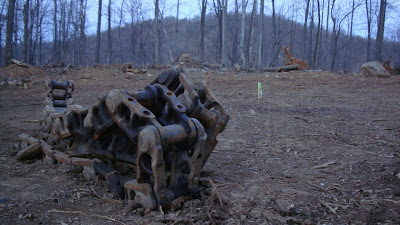
A big machine means big repairs - the dozer is due for new track chains.

[New track chains weighing close to 1000 lbs.]

First, have a look at the lot and check out the views; it was an amazing day on the mountain.  Although we've made significant progress we've still got some work leveling the building site and clearing more timber.

[A view from the northeast.]

[A view from the northwest.]

The weekend before last we broke down the tracks.  The track plates are in great shape; the previous owner replaced all the plates about a year ago.

[Track pads removed and sprocket exposed.]

The recent track pad replacement made it easy to turn the bolts.  To give you a little idea of how much work was involved, there are 32 track plates on each track and each plate had four bolts to remove.  That's 256 bolts that needed to be pulled and we still have a few plates to remove.

[Four or five of the 64 track pads that needed to be removed.]

After removing the plates, we replaced both drive sprockets weighing in at +100 lbs a piece.  Next came the two front pulley wheel assemblies weighing in at +200 lbs a piece.  At around 3:00PM on Sunday we were ready to start on the new track chains.

[One new sprocket gets mounted.]

Man handling track chain is no easy task.  Thankfully, Dad mounted a hydraulic lift to the back of his pickup to help move all the dozer parts into place.  Once the new track chains were laid out, we disconnected the old chain from the dozer and paired up both chains in the dirt.

[Dad torching and cutting out an pin in the old chain.]

As the anxiety set in, we moved the dozer inch by inch before quickly realizing that we forgot one very important detail; connect the two chains.  Moving the dozer along a disconnected track isn't as easy as it sounds and two chains should be connected with a pin before attempting to move the machine.

Working with come-a-long while using the bucket to lift the dozer off the ground we were able to connect the chains with a pin Dad had fabricated for the project.  Once the chains were connected, we moved the dozer onto the new chains.

Next weekend we'll roll the new chains onto the dozer and start mounting all 64 track pads and tightening their 256 bolts.  Anyone have a generator we can borrow?

[Telli checking out brother Barley.]